
Economic regulation agreement: toward a new strategic cycle for Groupe ADP
In late 2025, Groupe ADP unveiled its proposed economic regulation agreement (ERA) for 2027–2034. This industrial project involves a record investment plan of €8.4 billion in infrastructure and aims to gradually and durably transform Paris airports.
Meeting the challenges of today
The economic regulation agreement (ERA) is a key tool for regulating the airport sector. It provides the key economic stakeholders – government, airport operators and airlines – with the visibility they need. Based on long-term traffic projections, it sets the budget for infrastructure investments and service quality targets, and establishes guidelines for adjustments to airport fees.
Since the economic regulation agreement for 2016–2020 was signed, the environment in which Groupe ADP operates has changed significantly. The COVID-19 pandemic had forced Groupe ADP to operate without an ERA since 2020, and air transport now faces new environmental, societal and regulatory challenges, in addition to existing performance and competitiveness requirements. Against this backdrop of growing uncertainty, the need for a resilient industrial and economic model is more pressing than ever. While facing up to regulatory and tax pressures in France and increased global competition among hubs, the Group must succeed in stepping up the decarbonization of its operations and contributing to the sector’s energy transition, all while continuing to support growth in traffic.
"With this proposed economic regulation agreement, our aim is to establish a strong competitive position by creating the conditions for growth and increased efficiency among airlines, while improving the quality of service for passengers, all within a framework that requires restraint in development and the pursuit of the fairest economic balance between the airlines and Groupe ADP."
The new draft economic regulation agreement for 2027–2034 has three main objectives: to successfully transform Paris airports and strengthen the competitiveness of the Paris marketplace, while providing visibility and stability to all stakeholders.
A comprehensive and phased project
Investing in our airports and developing them with a long-term vision is the core business of Groupe ADP. Preparing for the future and continuing to grow by creating value for all is its duty. The industrial plan outlined in its proposed ERA approaches the coming decade based on the assumption of moderate traffic growth in Paris: approximately 1.6% per year on average.
Its main priorities are to create new passenger handling capacity, improve service quality, successfully reduce carbon emissions, and support the operational performance of airlines. Based on a restrained, modular, and phased approach to future development, the project will require €8.4 billion in investment over eight years – just over €1 billion a year on average – primarily to create capacity for an additional 18 million passengers.
With this investment program of unprecedented scale, Groupe ADP intends to fully embrace its role in transforming the sector. Its industrial plan for Paris is based on targeted, phased development. It consists of three main phases. Phase 1: between 2027 and 2030, streamline and improve passenger flows within the terminals; Phase 2: between 2030 and 2032, optimize and increase the capacity of existing infrastructure; and lastly, Phase 3: between 2032 and 2034, create new infrastructure and develop intermodality.
"Our proposed economic regulation agreement for 2027–2034 is based on a sustainable, balanced model that creates value for all stakeholders. For the hub and the airlines, it means greater competitiveness; for passengers, it means continuous improvement in service quality; and for the surrounding regions, it serves as a driver of economic development."
Public acceptance and economic balance
Public acceptance is at the heart of this proposal, and its industrial choices have been validated by two public consultations, “Paris-Orly 2035” in 2024 and “CDG&Vous” in 2025, as well as by the support of the airport community, including the airlines.
The draft ERA also establishes a new balance between performance, accountability, and competitiveness. It aims to strike the right balance between the cost of capital and an unprecedented level of investment, with the return guaranteed and capped by law, and the return on invested capital from airline fees that remain moderate and at the lower end of the range seen at other competing hubs.
The goal is to firmly establish the Paris hub in the global marketplace by highlighting its ability to create the conditions for the growth and increased efficiency of the airlines, and to improve the quality of service for passengers, all within a framework that prioritizes restraint in development and seeks the optimal economic balance between the airlines and Groupe ADP.
This project marks the beginning of a new strategic cycle. 2026 will be a pivotal year for negotiating with the government on the essential framework that the economic regulation agreement represents for airport operators, and thus a pivotal year for preparing the group’s future 2027–2030 strategic plan.
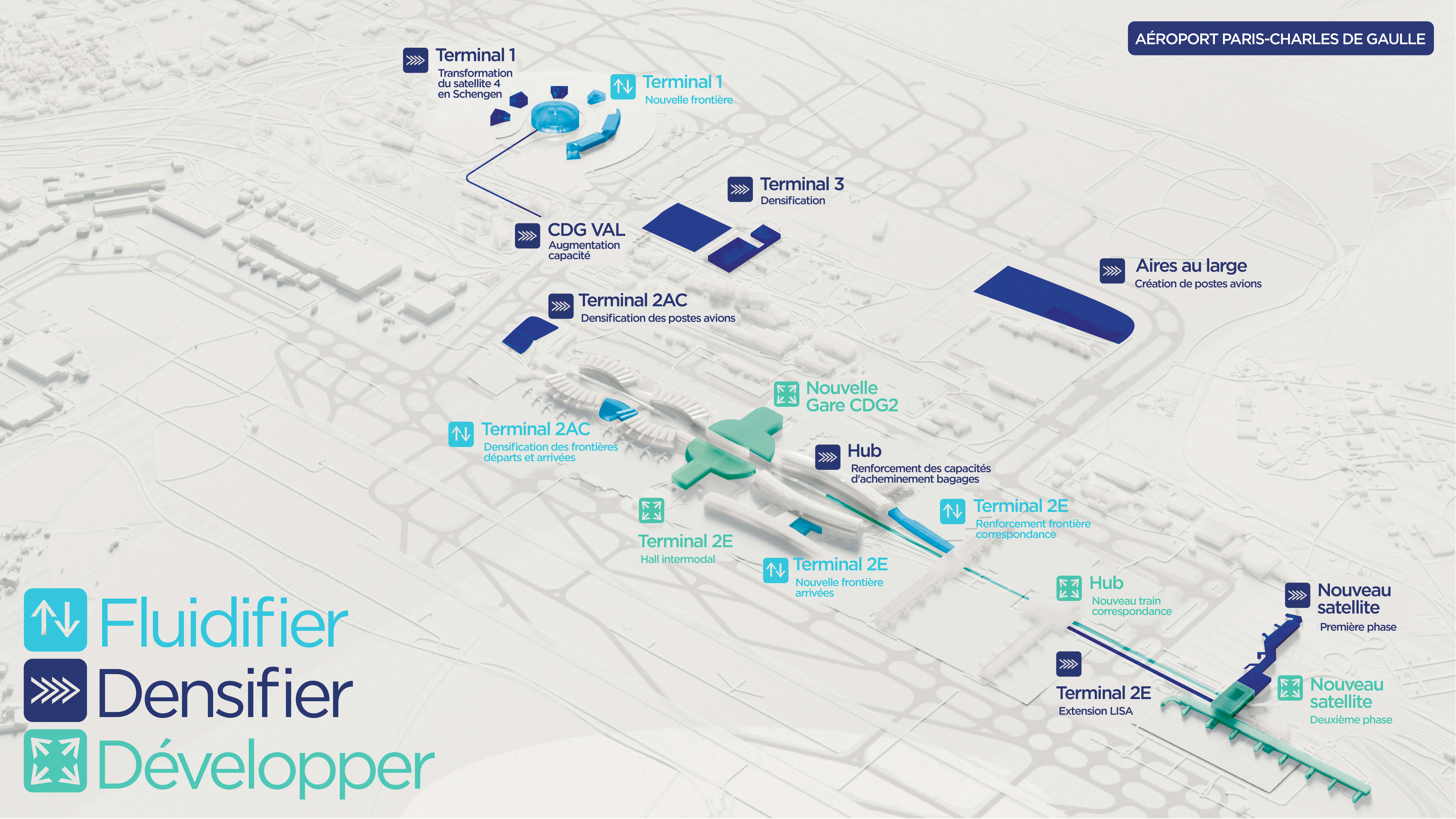
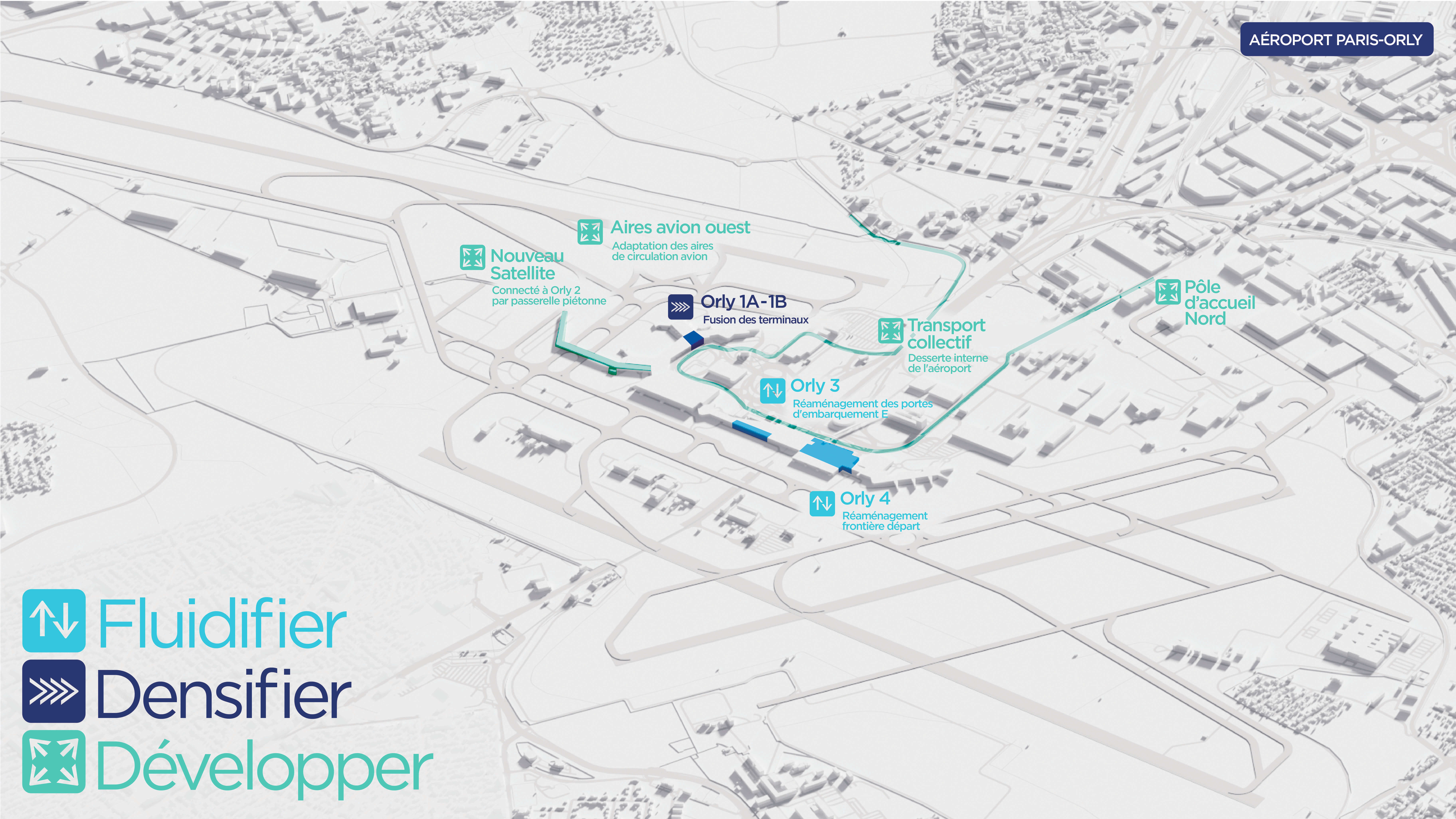
An industrial project in three phases:
2027-2030
- Streamline and improve passenger flows
- Reduce border waiting times
- Improve quality of service at checkpoints
- Improve the customer journey and experience
2030-2032
- Optimize and increase infrastructure capacity
- Increase terminal capacity
- Optimize airside capacity
- Simplify and secure baggage handling
2032-2034
- Build new infrastructure and develop intermodality
- Increase the number of contact stands for aircraft
- Make connections more efficient
- Facilitate intermodal journeys and improve connectivity with the regions
To learn more
- VOX: Enhancing passengers’ experience with the “Short Connexion Pass” – Interview with Pierre Abraham
- Article: Remaining a strategic hub at the heart of global realignment
- Article: CDG&Vous, giving the regions a say
- Article: Paris-Orly 2035: a pioneering airport
- Article: The new momentum in the aviation market is becoming clearer