
The Net-Zero Challenge for Airports
The air travel industry faces a major challenge: energy transition toward decarbonization. To meet the challenge of a new, more sustainable airport model, while preserving the ability of airports to link the entire world, Groupe ADP has embarked on a clear and ambitious path towards decarbonization, based on “net-zero emissions” targets as certified by the independent body SBTi, along with concrete action plans.
An ambitious path to net-zero emissions
Reducing carbon emissions is a major challenge that Groupe ADP intends to address with every industry stakeholder. For over 10 years, the company has been developing an active policy to reduce its environmental footprint, alongside its stakeholders, with the aim of aligning its decarbonization objectives with the 1.5°C temperature rise established in the Paris Agreements on climate.
Although the entire aviation industry pledged a commitment to carbon neutrality in global air transport by 2050 at the 41st Session of the ICAO Assembly, Groupe ADP has accelerated our climate commitment and set ourselves an ambitious and clear path.
The company’s action plans aim first to decrease internal greenhouse gas (GHG) emissions linked to direct airport operations (Scopes 1 and 2; see Note 1), by reducing energy consumption, creating more ecofriendly vehicle fleets and producing and using low-carbon or zero-carbon energy sources.
For external emissions (Scope 3, see Note 2) related to activities by other airport stakeholders (including airlines), the Group is pledging to provide access to equipment for electrifying ground operations, deploy new energies for both airplanes and ground transportation and prepare for the arrival of hydrogen-powered jets.
Decarbonization targets, validated by SBTi
In October 2024, Groupe ADP's decarbonization targets and 2050 objective (net-zero emissions across the value chain) were validated by the Science Based Targets initiative (see Note 3). This validation confirms that the Group’s greenhouse gas emission reduction targets are consistent with achieving the goals in the Paris Agreement.
"All of our teams are committed to decarbonizing our activities and we have an enormous responsibility to achieve the objectives of decarbonizing aviation. We must transform our airports into energy hubs, capable of producing and distributing low-carbon energy for the needs of the airport's users, airlines and also neighboring areas."
In the Paris region, Groupe ADP is aiming to achieve carbon neutrality through offsetting for its direct emissions (Scopes 1 and 2): it has been already reached in 2025 for Paris-Orly, and is expected by 2027 for Paris-Le Bourget and by 2030 for Paris-Charles de Gaulle. For those three Paris-area airports, that corresponds to a -68% reduction in direct emissions by 2030 and a 90% reduction by 2035 compared to the 2019 baseline levels.
As of net-zero decarbonization targets, certified by the SBTi, they also entail a 27.5% reduction in indirect emissions by our stakeholders by 2030 and a 90% reduction by 2050. This goal encompasses the entire value chain, including emissions from aircraft during takeoff and landing.
With regard to its network of international airports, Group ADP is aiming for carbon neutrality by 2030 for all our airports, and net-zero emissions by no later than 2050 for its 10 most important airports.
22 airports in the network are also participating in the ACI (Airport Council International) ACA (Air Carbon Accreditation) program, 12 of which had already achieved or exceeded the ACA 3+ rating – meaning carbon neutrality – by the end of 2025.
Tangible actions deployed at all Groupe ADP airports
Groupe ADP has identified heating, lighting and air conditioning as the priority means of reducing the impact of our main sources of direct emissions (Scopes 1 and 2), and accordingly we have defined some primary levers for achieving our decarbonization objectives.
In order to transform its energy mix and increase the share of renewable energy, Groupe ADP has made investment in solar power one of its key strategies, alongside geothermal energy, which was already in use at Paris-Orly and is now being expanded to Paris-Le Bourget Airport thanks to work connecting the site to the Dugny-Le Bourget geothermal heating network, and also at Paris-Charles de Gaulle thanks to a new deep geothermal power plant set to come online in 2026, which will meet 35% of the airport’s heating needs.
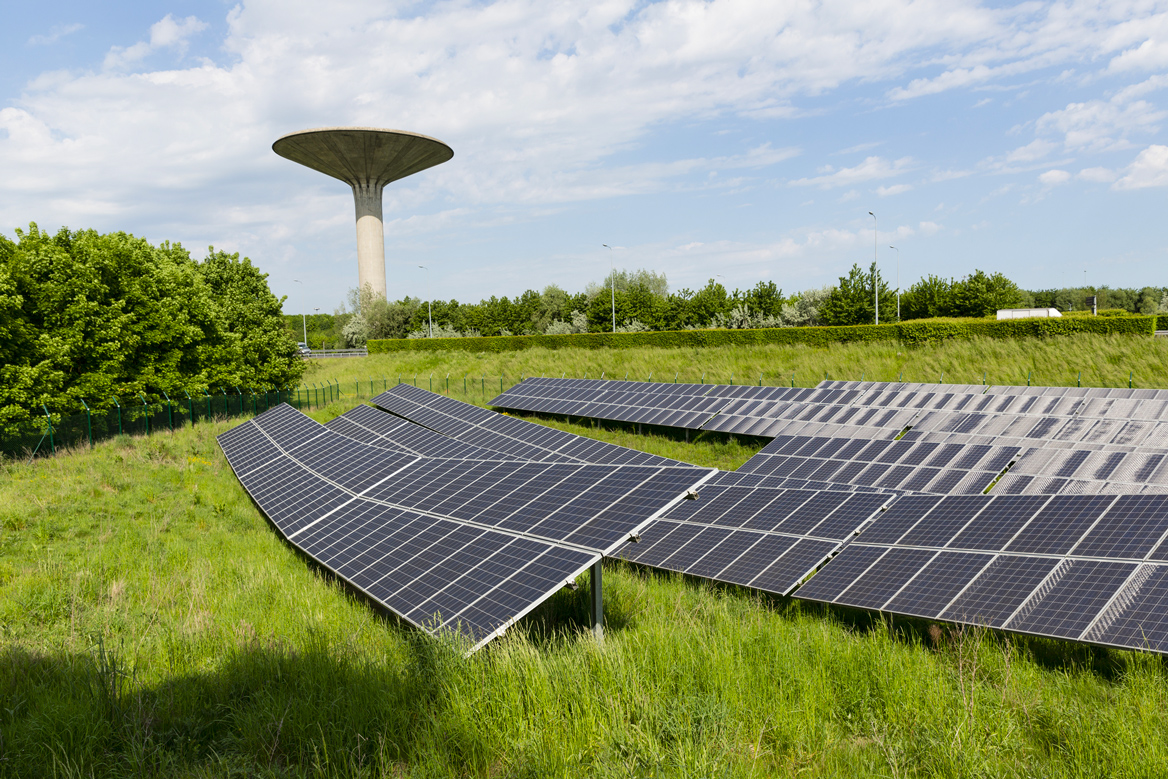
By expanding solar energy at its properties in Paris, in addition to our existing long-term contracts for the purchase of solar power, Groupe ADP aims to cover 30% of the electricity needs at our three Paris-area airports by 2030 with this carbon-free energy. Up to 200 hectares could be mobilized to expand solar photovoltaic power. Solar shade structures on parking lots will be developed first, followed by ground-level power stations on airport fields and agricultural areas, along with rooftop solar facilities on future buildings.
Similar actions are being carried out abroad. For example, TAV Airports has plans to develop solar photovoltaic plants at its sites in Ankara, Izmir, Alanya-Gazipasa, Milas-Bodrum, Antalya in Türkiye and at Enfidha in Tunisia. Jordan’s Amman Airport is aiming to meet 24.5% of its supply needs with the commissioning of a new 4.8-MW solar photovoltaic plant, before an expansion that will enable to reach an installed capacity of 10 MW by 2040.
The expanded use of solar photovoltaics will also make it possible to secure and decarbonize the energy supply for the production of hydrogen or sustainable synthetic fuels, which will benefit Group ADP's value chain. All of these initiatives are enabling us to design a new, more responsible and sustainable airport model.
LanzaJet: Supporting the development of sustainable aviation fuels
Groupe ADP is gradually transforming our airports into energy hubs, capable of offering electric power, sustainable aviation fuels and low-carbon hydrogen. In 2024, Groupe ADP announced a strategic investment in LanzaJet, a U.S. producer of sustainable aviation fuel, which has a large-scale, deployable technology: ethanol-to-fuel processing.
(1) Internal emissions: infrastructure heating and electricity, operation of our vehicles, etc.
(2) External emissions: ground emissions (access and ground operations), aircraft emissions (take-off, landing and complete flight path), and purchases of goods and services.
(3) The Science Based Targets initiative (SBTi) is an independent body that assesses the consistency of ambitious corporate GHG emission reduction targets with the Paris Climate Agreements, in accordance with the most recent scientific data on climate.