
The new momentum in the aviation market is becoming clearer
In 2025, Groupe ADP welcomed nearly 379 million passengers across its entire network of airports, a 4.2% increase over 2024. After the abrupt halt in growth caused by the pandemic in the early 2020s, 2024 had brought clear evidence of new momentum since Paris airports crossed the symbolic threshold of 100 million passengers welcomed – returning to their pre-crisis 2017 level – driven by strong growth in international traffic, particularly in Asia.
Global air traffic on the rise and seeing a transformation
Globally, traffic at Groupe ADP airports has returned above pre-Covid levels, driven by growth in Asian and emerging markets.
According to IATA(1), the number of air passengers hit a record high in 2024. Thanks to strong travel demand, IATA estimates that global traffic could reach 7.9 billion passengers by 2043, up from 4.5 billion in 2019.
according to IATA (vs 4.5 billion in 2019)
This growth is attributable to sociological and demographic trends, including regional urbanization and metropolitan development: more than 50% of the world’s long-haul traffic passes through 40 large megacities. Growth is also being driven by a shift in demand from mature economies to Asia and emerging countries, linked to the strong development of middle classes and a renewed appetite for travel. In 2015, 1 in 14 tourists worldwide was Chinese, and this ratio is expected to rise to 1 in 5 by 2030.
(vs 1/14 in 2015)
Source: IATA (International Air Transport Association)
This growth in worldwide air traffic is bringing several changes. Structurally, legacy airlines are increasingly competing with Gulf and Middle Eastern airlines that capture intercontinental traffic and connections to Asia and Africa. They face competition from low-cost airlines on the short and medium-haul market: low-cost airlines now hold 45% of the intra-European market.
Source: IATA
More moderate growth in Parisian traffic over the long term
In 2025, Paris-Charles de Gaulle welcomed nearly 72 million passengers, an increase of 2.5% over 2024, making it France’s largest airport and the third largest in Europe. With a connection rate of 29.5% in 2025, the Paris-Charles de Gaulle airport transfer hub is Europe’s fifth largest hub for the availability of global connections and the largest for intercontinental traffic. Paris-Charles de Gaulle serves more than 311 cities worldwide.
At Paris-Orly, traffic grew 2.6% compared to 2024, with 34.9 million passengers welcomed in 2025. For the two Parisian airports, this represents a 4.2% increase in traffic.
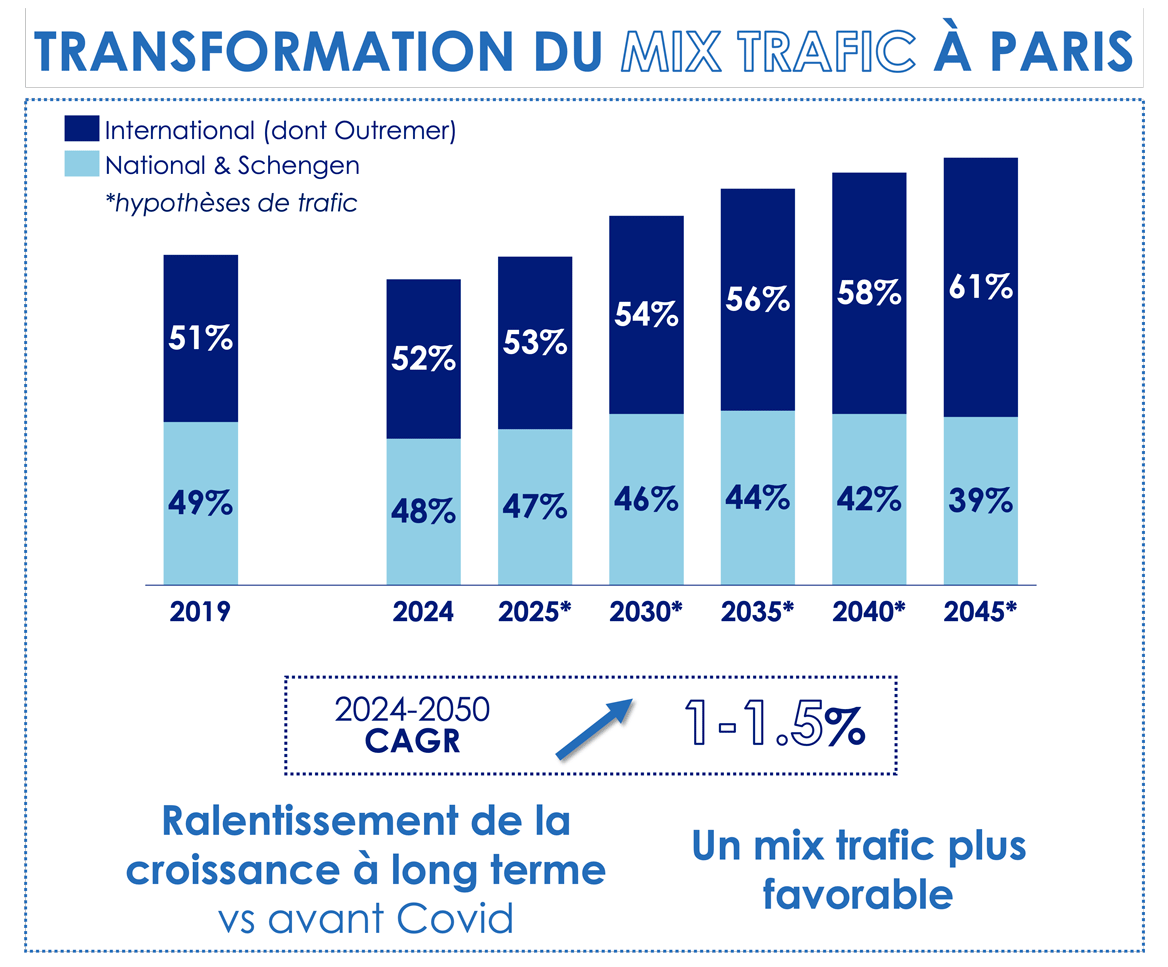
Compared to the period prior to 2020, when traffic doubled approximately every 15 years, the pace of growth is more moderate. We are seeing a gradual shift in the traffic mix toward more profitable international traffic. This change can be attributed to a more measured use of air travel, with a shift to other modes of transport: the train is increasingly preferred for shorter distances. Furthermore, the share of short and medium-haul flights (domestic and Schengen) is decreasing in favor of international routes (excluding Europe).
In other European countries and North America, growth in air traffic is similarly more modest than in the Asian region.
Growth prospects for Groupe ADP in the coming years
With regard to long-term traffic growth forecasts, Paris airports anticipate an increase of 1 to 1.5% annually between 2025 and 2050. Passenger traffic in 2026 is expected to increase by anywhere from 1.5% to 2.5% over 2025 levels.
TAV Airports, with its 15 international airports, confirmed its growth in 2025 with 113 million passengers for the year, a 6.3% traffic increase compared to 2024, and expects further growth. Following the opening of a new international terminal in 2024, Almaty airport’s total capacity exceeded 14 million passengers per year, marking the first step in a broader expansion strategy. Ankara Esenboğa International Airport (ESB) has moved forward with its program to modernize terminals and upgrade runway infrastructures.

GMR Airports, now listed on the Indian financial markets, has successfully completed its corporate restructuring at the holding level and is announcing major achievements at its airports: capacity expansion deliveries at Delhi and Hyderabad, as well as a concession agreement signed at Nagpur airport. With 121.3 million passengers (a 3.0% growth) in 2025 and its 7 airports across 3 countries, GMR Airports represents a strategic value-creation lever for the Group and also a driver to seize development opportunities in India and Asia.
The share of international operations at Groupe ADP is rising: its contribution to operating income is expected to increase from 15% in 2019 to between 25% and 35% in 2025 and to nearly 50% in 2035, before taking into account any new growth campaigns.
(1) IATA, the International Air Transport Association, comprising more than 240 airlines worldwide, is an industry leader in forecasting.